
Reflex Level Gauge
Reflex Level Gauge is used to visually indicate the liquid level inside tanks and vessels. It works on the principle of light reflection and refraction, where the liquid zone appears dark and the vapor or gas zone appears bright, making the level clearly visible. This type of level gauge does not require external lighting during the day and provides clear and reliable indication. It is simple in design, easy to install, and requires low maintenance. Reflex level gauges are widely used in process industries, boilers, and storage systems where quick and accurate level indication is required.
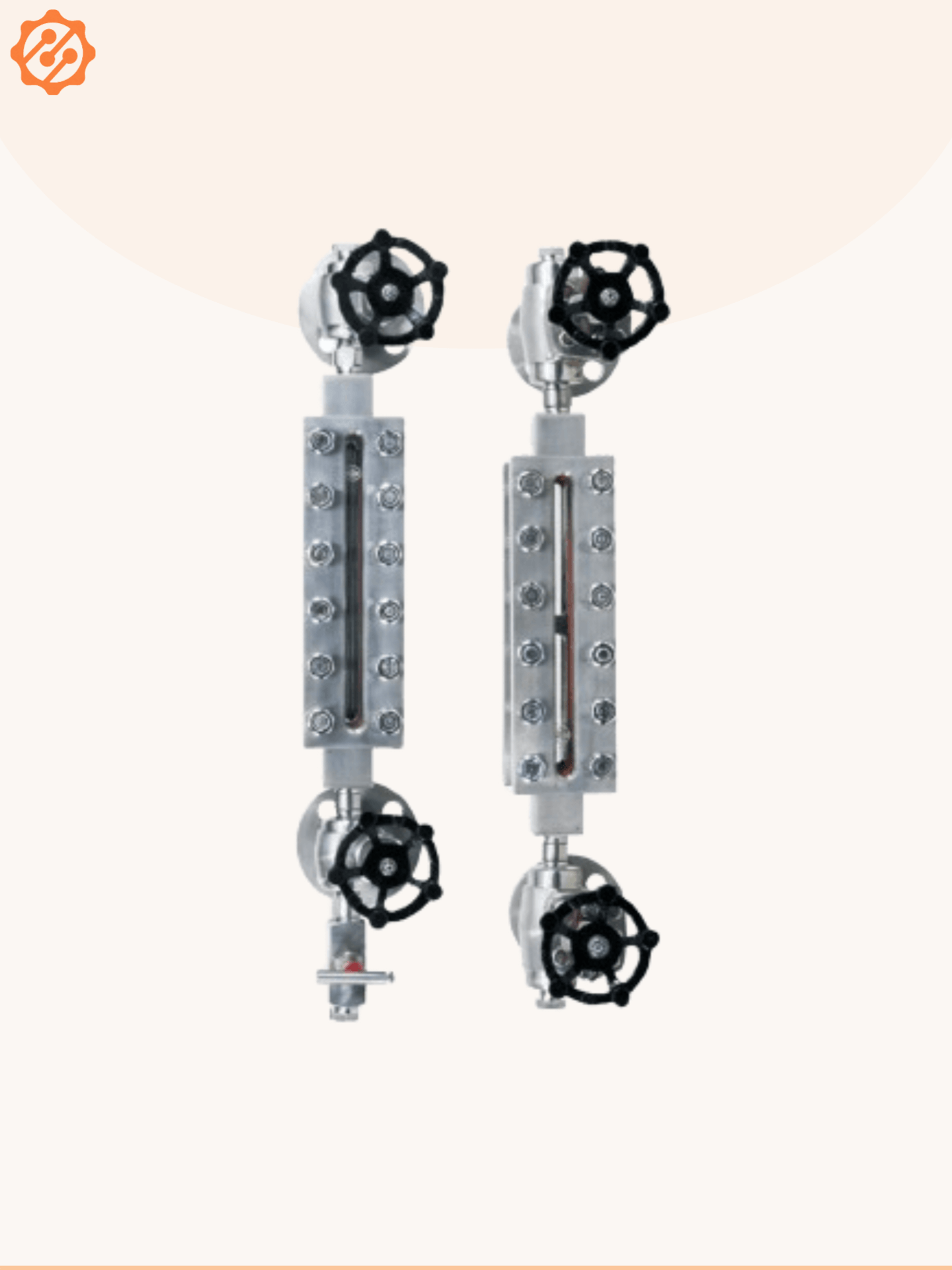
Reflex Level Gauge
Code: RLG-FL, Model: NA
Product Details
Working Principle
Reflex glass level gauges working principle is based on the light refraction and reflection laws. Reflex glass level gauges use glasses having the face fitted towards the chamber shaped to have prismatic grooves with section angle of 90°. When in operation, the chamber is filled with liquid in the lower zone and gases or vapors in the upper zone; the liquid level is distinguished by different brightness of the glass in the liquid and in the gas/vapor zone. The reflex level gauges do not need a specific illumination: the day environmental light is enough. Only during the night an artificial light must be provided.
The different brightness in the two zones is obtained as explained below:
Liquid Zone
This zone appears quite dark when the gauge is in operation and lighted as above said. Given the construction, most of the environmental light rays incident on the external face of the glass are quite perpendicular to said face and, therefore, not deviated by the glass. These rays reach the glass/liquid interface with an inclination of approx. 45°. The critical angle glass/liquid is always superior to 45°. Therefore the rays incident within the critical angle (practically the totality) are refracted within the liquid and, since the internal walls of the gauge chamber are not reflecting, the rays cannot be seen from the outside. In fact the zone will appear dark, nearly black, to the observer.
Gas/vapor Zone
This zone appears almost silver bright to the observer. As for the liquid zone, the light rays reach the glass/vapor interface with an angle around 45°. Since this angle is greater than glass/gas-vapor critical angle, the rays are not refracted, but totally reflected making 90° turn, thus reaching the nearest glass/gas-vapor interface again with angle of 45°. For same reason they will be reflected and turned by 90° towards the observer, to whom the zone will appear silver bright.
Applications
Reflex glass level gauges can be used in most of the cases and offer great advantages in terms of: low initial cost, low operating cost, easy level reading.
- Reflex level gauges cannot be used in certain cases as for example:
- When the separation level between two liquids has to be read (interface)
- When besides the level indication, the observation of the liquid colour is required
- When the process fluid is high-pressure water steam, since in this case the glass must be protected from the solvent action of the boiler water by using mica shields
- When the process fluid is such that can corrode the glass (e.g. high temperature alkaline solutions or hydrofluoric acid), since mica shields or Polytrifluoroethylene shields must be used to protect the glass
Specifications
| Type | Reflex / Transparent |
| Material Of Construction | Toughned Borosilicate Imported Kinger / Maxos / Indian make |
| Material Of Body | CS/SS 304 / SS316/PP/PTFE |
| Material Of Cover Plate | CS to ASTM A-105 (Non wetted parts) |
| Valve Type / Design | Ball Check / Auto Shut-off |
| Valve Body Material | CS/SS 304/SS316/PP/PTFE |
| Valve Trim Material | SS 316/SS-304 |
| Vent / Drain Connection | 1/2" NPT(F) with plug (or) to mention |
| Material Of U-Bolts, Studs & Nuts | SS 316 MS, EN-8, SS or to mention |
| Gaskets / Seals | CAF, AF 120, PTFE |
0
Verified Reviews for Reflex Level Gauge
Your Opinion Matters
We continuously evaluate and elevate our industrial engineering quality and delivery metrics based on client data.
View & Write Reviews